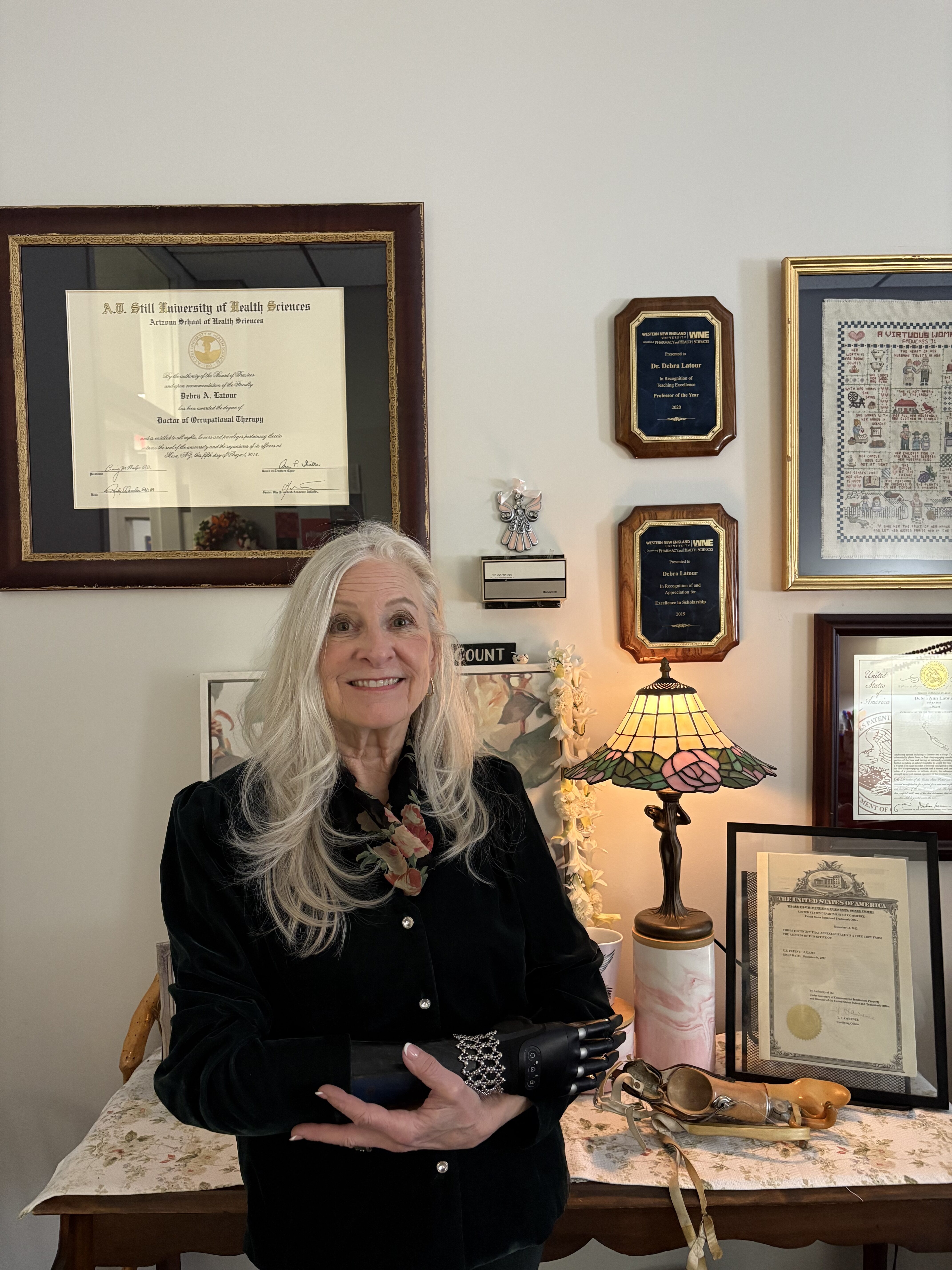
Sitting Down with Debi Latour, Coapt User and OT
Debi Latour, O.T.D., M.E.d., OTR/L, FAOTA, is an occupational therapist specializing in upper limb prosthetic rehabilitation whose career uniquely bridges personal insight and clinical expertise.
Born with a congenital upper limb difference, Debi brings both the perspective of a prosthesis user and the expertise of an OT. This dual lens gives her a deep understanding of upper limb prosthetic function, and of what pattern recognition technology can mean for the people who rely on it.
Today, Debi wears a TASKA™ device powered by Coapt. We sat down with her to learn more.
What do you love most about your Coapt-powered device?
One of the biggest advantages for me is how simple Coapt makes it to use my TASKA CX™ hand. I am able to more easily switch grips.
I no longer have to press the buttons on the back of my prosthetic hand to switch grips.
As an occupational therapist, I’ve seen that this is cumbersome when users use their intact hand to reach across their body and press buttons on the prosthesis.
Now, with Coapt pattern recognition, I use muscle pattern recognition and can switch grips and control my device directly through my own muscle signals inside my socket, no button pressing required. For example, when I want to use my TASKA’s flexi‑tool grip, I activate muscles in a pattern that matches what my body thinks using a thumb would feel like. To open the hand, I use the dorsal aspect, engaging the same kind of extensor pattern we use naturally. Coapt lets those instinctive, authentic motions become functional prosthetic control. It mirrors how the body actually works.
How did you learn to use pattern recognition technology?
Originally, it was thought that someone with congenital limb difference might not be able to learn to use pattern recognition that well because we haven’t had the experience of using a hand or an extended arm on our involved side.
But I learned that with the right strategies, I could use pattern recognition technology. I used a form of mirror therapy where I would complete a movement with my intact side and try to mimic that on my limb difference side to ‘teach’ my muscles how to generate consistent patterns. It became a process of exploration, figuring out what my body could do and translating that into control that felt natural using the Coapt technology.
Can you share more about your experience with Coapt’s Control Companion mobile app?
As an OT, it’s a wonderful way to motivate my patients to be able to improve their abilities and to get to know their device. Many of us use more than one type of technology, and sometimes it can be a little problematic learning how to use the different devices and use them in different ways to perform some of the same common tasks. Using the app, especially the games and the training programs, can really help with that.
As a user, I also like it because then I can work on my own self-improvement and try to refine my skills on my time. I love being able to constantly update my calibrations, particularly with different arm movements or in different positions and even with different tasks.
I encourage my patients to do the same, to explore, use the app, and test themselves as well as calibrate frequently.